

At the core of Vitalgenics is a series of regenerative products we call VitalMax Stem Cells. The VitalMax regenerative products are derived from umbilical cord blood and have been evaluated, tested, and certified by third-party labs for their safety and potency (see below). All the VitalMax regenerative products uphold the same level of quality with the only difference between them being the concentrations of stem cells contained therein.
We offer customized concentrations for specific regenerative therapies that give regenerative practitioners flexibility in procedures and costs. Our laboratory partner has been in the business of collecting, processing and storing umbilical cord blood for over two decades. You will be hard-pressed to find a higher quality product on the market, and as you know quality translates into results.
In many treatments, something called the engraftment potential is determinant on the number of viable cells that survive this reconstitution. Engraftment is the process by which the transplant recipient's tissues accept the product(s) and respond through cellular regeneration and repair. The reagents and methodologies our lab partner uses in the collection, processing, and preservation of these biologics enables VitalMax Stem Cells to boast the finest post-thaw cell recovery in the industry. This translates to increased engraftment potential and faster potential results.
A key success factor to superior cord blood processing is the removal of RBCs from the harvested umbilical blood. RBCs do not survive the cryopreservation and thawing process and their cell membranes rupture and introduce a host of contaminants to transplant administered. These contaminants cause illness. VitalMax Stem Cells have been shown to be 98.5% free of RBCs due to an advanced technique/reagent our laboratory partner uses. Safer transplants mean better patient results.
Every procedure performed on the biologics to produce VitalMax Stem Cells, from collection to cryopreservation, are approved and regulated by both the FDA and American Association of Blood Banks (AABB). Additionally, the Standards set forth by the National Marrow Donor Program (NMDP) are also strictly followed and every regulatory requirement exceeded. VitalMax Stem Cells undergo continual inspection which ensures we only provide the best.
Vitalmax Muse Cell Exosomes are distinguished by their origin from multilineage-differentiating stress-enduring (Muse) cell populations, a unique subset of endogenous reparative cells identified for their resilience and biological signaling capacity. Exosomes derived from these cells carry a concentrated profile of bioactive molecules—including proteins, lipids, mRNA, and microRNA—that play a critical role in intercellular communication. This signaling network supports cellular coordination within the tissue microenvironment, making Muse cell–derived exosomes an area of increasing interest in regenerative and translational research.
Vitalmax exosomes are produced through controlled laboratory processes designed to preserve structural integrity and signaling activity, followed by purification and concentration steps to isolate extracellular vesicles of interest. Each batch undergoes comprehensive quality assessment, which may include particle characterization, sterility testing, and verification of key biological markers associated with extracellular vesicles. This commitment to consistency and transparency supports practitioner confidence and aligns with evolving standards in biologic processing and handling.
What sets Vitalmax apart is its focus on Muse cell–associated signaling biology, combined with a structured, clinician-oriented delivery model. Rather than positioning exosomes as a standalone solution, Vitalmax is designed to integrate into physician-directed care frameworks, complementing existing therapeutic strategies and supporting patient-specific protocols. This approach emphasizes responsible use, clinical consistency, and the growing role of cell-derived signaling technologies in modern regenerative medicine.
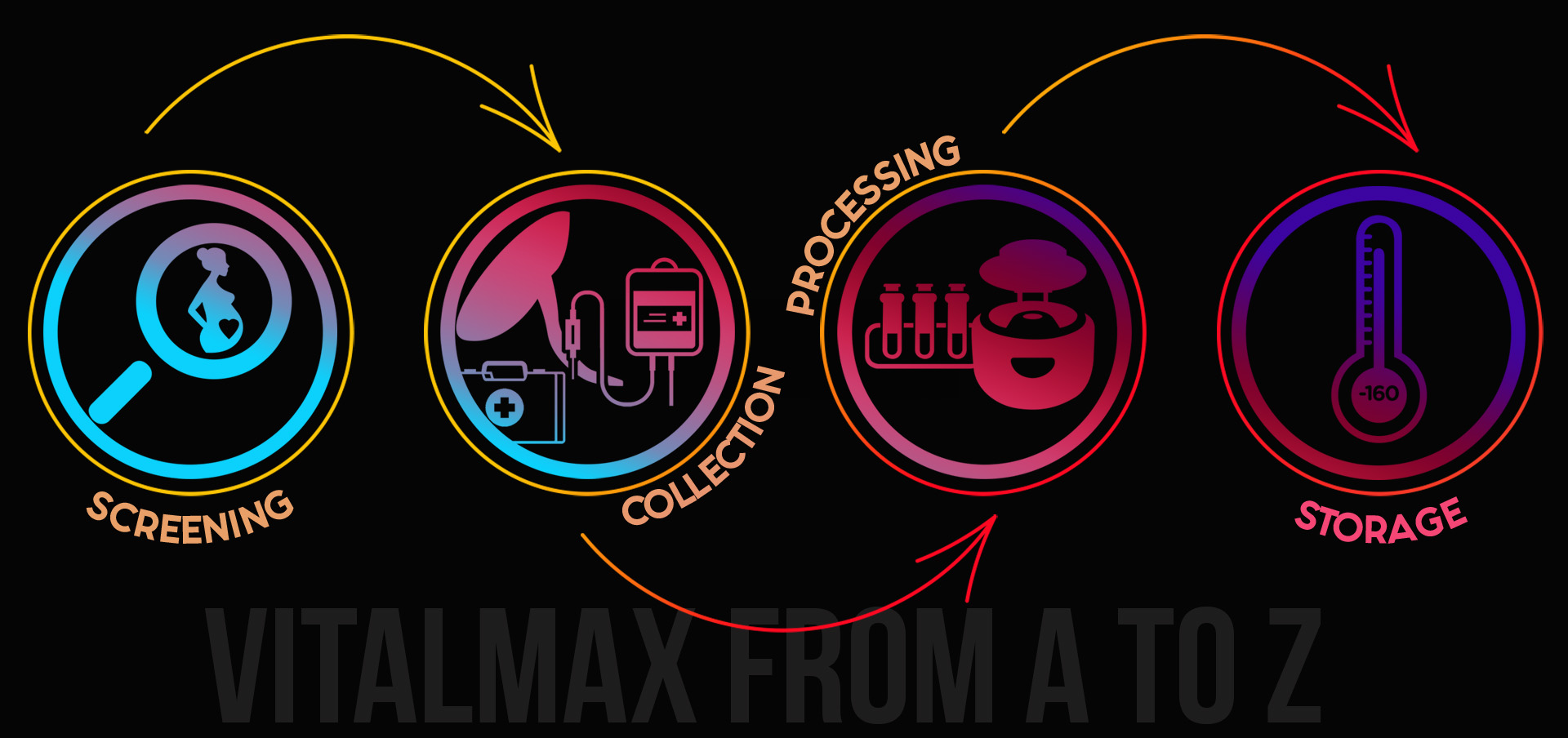
SCREENING
Prior to our biologics even being collected, a complete donor medical history, physical and behavioral assessment, and an extensive set of serological tests are performed on the donor. This ensures the donor is a good candidate for the program, being free from disease and also exhibiting high standards of health. All of our collections are performed on donors delivering here within the USA.
COLLECTION
The umbilical cord blood collected is done so aseptically at the time of delivery from healthy pregnant women. Advanced cord blood collection bags containing the only FDA-approved anticoagulant (citrate phosphate dextrose) are always used which aide to increase cell yield and higher levels of treatment success. Harvested specimens are quickly transferred to one of many national processing labs.
PROCESSING
Processing only occurs on freshly collected cord blood that was harvested under aseptic and GMP standards, then further serological tests are performed. The red blood cells, granulocytes, and other non-useful biologics are removed leaving only stem cells in the product. Final tests for growth, viability, and cell counts are performed prior to cryopreservation.
STORAGE
A key reagent is used as the freeze media. This reagent is designed to protect cells at ultra-low temps and prevent intracellular ice. This added protection ensures higher cellular recovery & viability when it comes time for thawing. Cells are frozen at -1°C/minute in a -80°C freezer, and then transferred to liquid nitrogen where they are maintained for storage between -135°C and -160°C.
Each Vitalmax biologic preparation is supported by a comprehensive Certificate of Analysis (COA), providing batch-specific verification of critical quality attributes. Quality control includes extensive microbial testing for bacterial and fungal contaminants, as well as validated mycoplasma screening to detect subclinical contamination. Endotoxin testing is performed to ensure levels remain within established safety thresholds. To further enhance transparency and reliability, third-party analytical verification is utilized where applicable to confirm key product characteristics.
Advanced analytical methods are employed to characterize both cellular and extracellular components. This includes verification of cell counts and viability, along with MSC marker panel analysis (e.g., CD73, CD90, CD105) to confirm phenotype consistency. For extracellular vesicle characterization, Nanoparticle Tracking Analysis (NTA) and Tunable Resistive Pulse Sensing (TRPS) are used to assess particle size distribution and concentration. Additionally, post-thaw analysis is conducted to evaluate product integrity and functional stability following cryopreservation.
Collectively, these multilayered validation processes support consistency, traceability, and quality assurance, aligning with current best practices in biologic processing and providing clinicians with a high level of confidence in product handling and performance characteristics.
Join the Vitalgenics Practitioner Network (VPN) and get exclusive product discounts, proven clinical protocols, and complete marketing systems – everything you need to launch & scale your regenerative practice.